

Dún Aonghasa: The Fort on the Edge of Europe
Dún Aonghasa: The Fort on the Edge of Europe
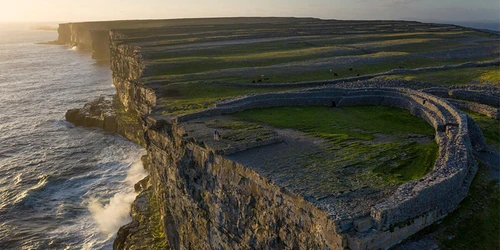
On the western side of Inis Mór, the largest of the Aran Islands, the land rises gently through stone walls and limestone pavement. Then it stops. Dún Aonghasa sits on that last edge: a ring of drystone walls built around 3,000 years ago, its innermost enclosure open to a sheer drop of roughly 100 metres into the Atlantic.
There is no fence at the cliff edge. Nothing stands between you and the ocean except the wind, which on most days is doing its best to remind you where you are. It is one of the most remarkable prehistoric sites in Europe, and one of the most unforgettable places to stand in Ireland.
Walls, stones and a sheer drop
Dún Aonghasa is built as a series of massive drystone walls curving out from the cliff edge, like ripples frozen in stone. The innermost enclosure is the most striking: a high, thick-walled citadel with wall walks, small chambers and steps built into the stone, its open side ending abruptly at the cliff. The outermost wall takes in an area of around six hectares.
Between the walls lies the fort's most menacing feature: a broad band of chevaux-de-frise. This is a dense field of jagged limestone slabs set upright in the ground, some up to 1.5 metres tall. They were designed to slow and break up anyone approaching on foot. Very few sites in Ireland have them, and the example at Dún Aonghasa is widely regarded as the finest anywhere.
Much of what you see today was repaired in the late 19th century, after the fort was taken into state care as a National Monument. The scale, though, is entirely original. Every stone was gathered and placed by hand, with no mortar, on an island with almost no soil and no timber.
Three thousand years on the edge
For a long time no one knew how old Dún Aonghasa really was. That changed between 1992 and 1995, when archaeologist Claire Cotter led four seasons of excavation there for the Discovery Programme's Western Stone Forts Project.
The dig showed that the first fort was built in the Late Bronze Age, around 1100–1000 BC. People lived inside it in round stone huts. They cooked meat and shellfish and cast bronze on site: fragments of clay moulds and a small hoard of bronze rings turned up just a few metres from the cliff edge. Radiocarbon dates from animal bone show people were on this exposed plateau even before the first walls went up.
The fort was later rebuilt on a grander scale in the early medieval period, around AD 700–800, when its walls were roughly doubled in thickness. What it was for is still debated. It may have been a stronghold, a centre of power for the island's community, a place of ceremony, or all three. Building a citadel this ambitious on the very edge of Europe was a statement as much as a defence.
The name means "the fort of Aonghus". In Irish tradition it is linked to Aonghus mac Úmhór, a leader of the Fir Bolg, a mythical people said to have settled the islands after being driven west. The legend is far younger than the stones, but it has clung to the place for centuries. The earliest written account of the fort, by Roderic O'Flaherty, dates from 1684.
Visiting Dún Aonghasa
Most visitors arrive by ferry at Kilronan, the island's main village. From there the fort is a few kilometres west, at Kilmurvey (Cill Mhuirbhigh). You can cycle, take a minibus or a pony and trap, or walk if you have the time. Bike hire is easy to find near the pier.
The Office of Public Works runs the site, which is open all year. Its visitor centre at the foot of the hill reopened in May 2026 after a €1.6 million upgrade, with a new exhibition on the fort and its story. Check Heritage Ireland for current opening times and admission.
From the visitor centre, it is about 1 km uphill to the fort, roughly 20–30 minutes each way. A few practical tips:
- Wear proper footwear. The final stretch is over rough, natural rock and can be slippery, especially on the way down.
- Respect the edge. There is no fence or barrier at the cliff, and gusts can be sudden. Keep well back, and keep children close.
- Leave the drone at home. Drones are not permitted at the site.
- Go early or late. The fort is quietest before the day-trip ferries arrive and after they leave. Stay overnight and the evening light over the Atlantic is worth it alone.
From stone walls to wool
Stand inside the walls of Dún Aonghasa and the Aran Islands start to make sense. This is a place of stone, wind and sea, where people have always had to build carefully, waste nothing and make things that last.
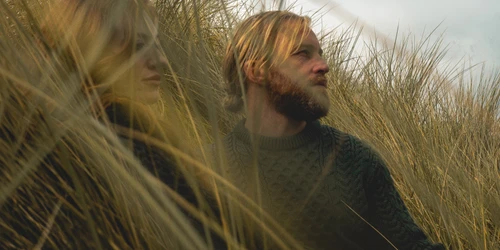
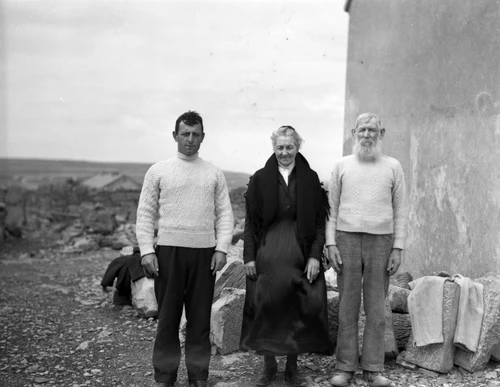
The same islands gave the world the Aran sweater: dense, hard-wearing wool knitted to keep out the Atlantic weather. So when we set out to design a sweater in honour of the fort, we wanted it to feel like those walls: solid, layered and built to endure.
The result is our Men's Dún Aonghasa Heavyweight Aran Sweater. Its Honeycomb and Cable stitches interlock across the body the way the fort's drystone courses lock together, each one holding the next in place. Like the walls, it is built for weight and warmth. We knit it with three ends of wool for extra thickness, ready for a blustery walk along the cliffs or a cosy evening by the fire once you are home.
Three thousand years after the first walls rose on Inis Mór, that spirit of patient, lasting craft is still very much alive. You can wear a little of it.